The Biggest Feathered Paradise on the Planet: The Ultimate Guide to Birds in Manu and Tambopata
If you are an ornithology enthusiast, a nature photographer, or simply a traveler looking to witness the most astonishing spectacles of the natural world, you need to know this: southern Peruvian Amazonia is the world capital of birds.
With over 1,000 recorded species—accounting for nearly 10% of all bird species on the planet within a single territory—regions like Manu National Park and the Tambopata National Reserve (in Madre de Dios and parts of Cusco) are the holy grail for any wildlife watcher.
Here we take you on a detailed journey through the most colorful, exotic, and elusive feathers of southern Peru’s jungle, featuring routes, key species, and sighting secrets.
🗺️ 1. Manu vs. Tambopata: Two Giant Scenarios for Birdwatching
Although both are located in the same southern Amazonian basin, their geographies offer completely different birdwatching experiences:
-
Manu National Park (Cusco and Madre de Dios):
-
The strength: Its altitudinal gradient is unique in the world. It begins in the high Andes (over 3,500 meters above sea level) with puna and cloud forest species, and winds down to the Amazonian plain.
-
Ornithological advantage: By crossing so many ecological floors in just a few hours of travel, you can record high-altitude endemic species and then deep-jungle species all in a single trip.
-
-
Tambopata National Reserve (Madre de Dios):
-
The strength: Pure low jungle, winding rivers, oxbow lakes (cochas), and famous clay licks (collpas).
-
Ornithological advantage: Massive concentrations of parrots, macaws, and waterbirds. It is the ideal place if your goal is to see large flocks and do photography with excellent lighting in open marshes.
-
🎨 2. The Winged Stars: Iconic Species You Must See
The Andean Cock-of-the-Rock (Rupicola peruvianus) — National Bird of Peru
-
Where to find it: In the cloud forests of the eastern slopes of the Andes (Manu, route to the high jungle).
-
Why it’s unique: The males have a brilliant orange-red plumage and a fascinating discoidal crest. They gather every morning in spaces called leks to perform collective courtship dances, hopping from branch to branch and emitting guttural sounds to impress females. It is one of the most extraordinary visual spectacles in South America.
The Hoatzin or Shansho (Opisthocomus hoazin)
-
Where to find it: On the shores of oxbow lakes and swamps in Tambopata and Manu.
-
Why it’s unique: It looks like a living dinosaur. It has a messy crest on its head, featherless blue facial skin, and intense red eyes. It is famous for being one of the very few birds with a folivorous herbivorous digestion (eating leaves) similar to that of cows, which gives it a very peculiar odor (hence locals call it the “stinky bird”). Additionally, chicks retain claws on their wings to climb branches if they fall into the water.
The Harpy Eagle (Harpia harpyja)
-
Where to find it: Deep inside the best-preserved primary forests of Manu and Tambopata.
-
Why it’s unique: It is one of the largest and most powerful raptors in the world. With claws the size of a grizzly bear’s and tremendous strength, it is the apex predator of the forest canopy, capable of hunting monkeys and sloths. Seeing one in the wild is the ultimate dream of any ornithologist.
The Amazonian Umbrellabird (Cephalopterus ornatus)
-
Where to find it: In the humid forests of Manu.
-
Why it’s unique: It stands out for its brilliant black plumage and a distinctive head crest that looks like an open umbrella, accompanied by a feathered dangling wattle on its chest that it inflates to emit low-frequency sounds.
🧱 3. The Spectacle of Macaw Clay Licks (Collpas)
One of the reasons Tambopata and Manu are world-famous is their clay licks.
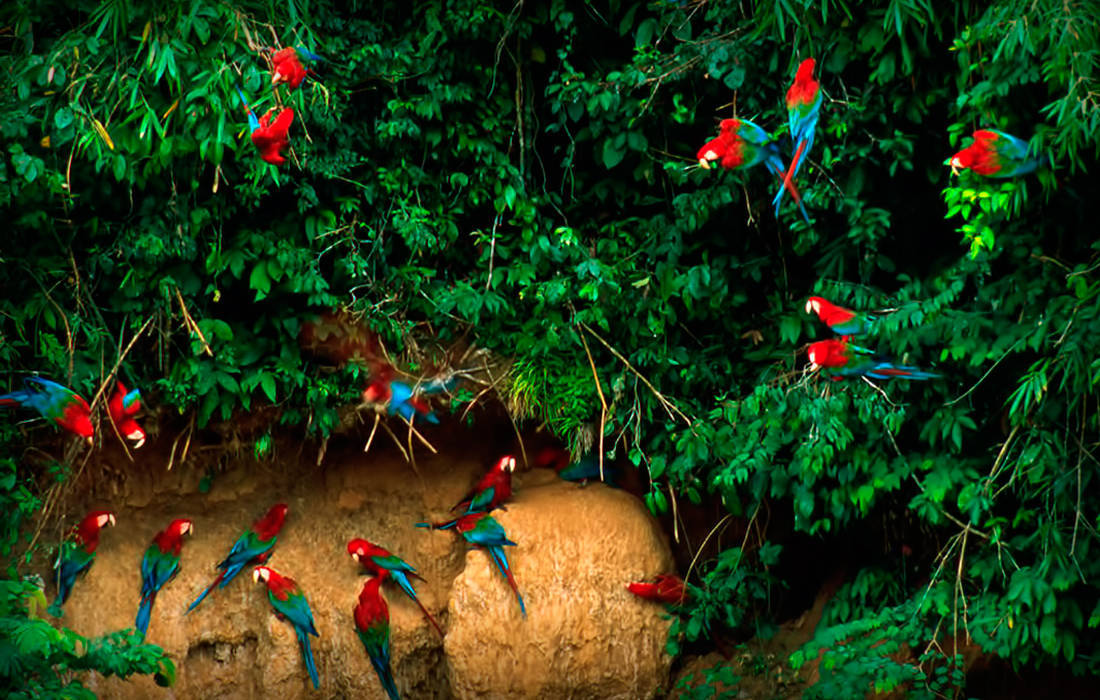
Every morning when the sun rises, hundreds of parrots, parakeets, and large macaws (such as the Scarlet Macaw and Red-and-green Macaw) land on clay cliffs along riverbanks.
-
Why do they do it? The clay contains essential minerals and sodium that neutralize toxins from the green seeds and fruits they consume in their daily diet.
-
The visual spectacle: It is a deafening explosion of scarlet, yellow, blue, and green contrasting against the brown mud and the green of the jungle. Guides set up floating or shore blinds so photographers can capture close-up shots without disturbing the birds.
🛶 4. Oxbow Lakes and Waterbird Refuges
Ancient river meanders separate over time, forming horseshoe-shaped lakes (like Lake Sandoval in Tambopata or Lake Salvador in Manu). These calm water mirrors host unique ecosystems:
-
The Hoatzin and screamers inhabit the floating vegetation shores.
-
Herons, kingfishers, and cormorants patiently compete for fish.
-
The Neotropic Cormorant and jabirus swim silently among families of giant river otters.
🎒 5. Essential Tips for Birdwatching in the Southern Jungle
-
Invest in a good specialized guide: Jungle birds camouflage themselves perfectly in dense foliage. A local guide with a spotting scope and trained ear makes the difference between seeing 10 species or 80 in a single day.
-
Key equipment:
-
Binoculars: Essential (recommended 8×42 or 10×42 with good luminosity for the dark corners of the forest).
-
Telephoto lens: If you enjoy wildlife photography.
-
Neutral-toned clothing: Avoid fluorescent or very flashy colors; olive green, brown, or gray will help you blend in.
-
-
Dawn is sacred: Ornithological activity peaks between 5:30 a.m. and 9:30 a.m. Prepare to wake up early; the reward is worth every second of lost sleep.