Is Sandoval Lake Worth It? Cost, Wildlife, and Best Eco-Lodges in Tambopata
The Amazon evokes images of dense vegetation, winding rivers, and a constant symphony of creatures hidden in the canopy. However, for many travelers planning their Peru itinerary, a major question arises: how can you experience the true lungs of the world without spending days traveling by boat into the inaccessible depths of the jungle? The short and definitive answer is Sandoval Lake.
Located within the prestigious Tambopata National Reserve in the department of Madre de Dios, this spectacular oxbow lake has established itself as one of the most coveted ecotourism destinations in South America. Despite its relative proximity to the city of Puerto Maldonado, Sandoval Lake is home to a biodiversity so rich and concentrated that it directly competes with the most isolated corners of the Amazon basin.
In this comprehensive and ultra-detailed guide, we will critically analyze whether it is truly worth investing your time and budget in this destination. We will examine the real costs, the wildlife you will actually see, the climatic and geographical conditions, and compare the best eco-lodges in the region so that your adventure in the Peruvian rainforest is simply unforgettable.
1. Introduction to Sandoval Lake: The Emerald Heart of Tambopata
To understand the biological value of Sandoval Lake, we must first understand its geographical origin. Hundreds of years ago, this body of water was part of the main course of the Madre de Dios River. Over time, due to sedimentation and the forces of the currents, the river changed its course, leaving behind an abandoned meander, or oxbow lake.
This relative isolation created a semi-closed ecosystem characterized by calm waters and dense wetlands dominated by the Mauritia flexuosa palm, locally known as aguaje. These palm swamps are the supermarket of the Amazon; their fruits feed thousands of species of birds, mammals, and insects, making Sandoval Lake a magnet for wildlife.
Strategic Geographical Location
Geographically, the lake is located in southeastern Peru, very close to the borders with Bolivia and Brazil. Administratively, it belongs to the district and province of Tambopata. What makes this place so special is its accessibility:
-
Flight from Lima/Cusco to Puerto Maldonado: A short domestic flight (approximately 45 to 90 minutes).
-
Boat Ride: A scenic 30 to 45-minute navigation down the mighty Madre de Dios River from the city’s main port (Puerto de Capitanía).
-
Jungle Hike: A flat 3-kilometer (approximately 2-mile) trail that plunges into the primary rainforest of the Tambopata National Reserve until reaching the canal that accesses the lake.
Unlike Manu National Park or Bahuaja-Sonene National Park, which require multi-day land and river expeditions, Sandoval Lake allows you to be surrounded by pristine primary rainforest just a few hours after landing at the airport.
2. The Definitive Verdict: Is It Really Worth It?
Let’s address the million-dollar question head-on. Yes, Sandoval Lake is absolutely worth it, but with certain caveats that depend directly on your expectations as a traveler. It is not a one-size-fits-all destination, so it is vital to weigh its pros and cons before packing your rubber boots.
The Undeniable Pros
-
High Wildlife Density: Being a closed aquatic environment surrounded by primary forest, animals do not have to disperse across thousands of kilometers of dry land. They concentrate along the shores to feed, drink, and nest.
-
Silent Navigation: Motorized boats are strictly prohibited on Sandoval Lake. All excursions are conducted in wooden canoes propelled by paddles by local guides. This ensures zero noise pollution, allowing you to get within a few meters of highly elusive animals.
-
Time and Cost Efficiency: It is the perfect Amazon destination for those on a tight itinerary in Peru (for example, a 3-day or 4-day trip after visiting Machu Picchu in Cusco).
-
Picture-Perfect Landscapes: Sunrise and sunset on the lake offer a mirror-like reflection of the sky and trees on the water, creating a mystical and photogenic atmosphere that few places on Earth can replicate.
The Challenges and Cons
-
Presence of Other Tourists: Due to its well-deserved fame and accessibility, Sandoval Lake receives a steady flow of daily visitors. If you are looking for an experience of absolute isolation where you are the only human being for 50 kilometers, you might prefer the upper Tambopata River or the Heath River.
-
The Entrance Hike: The 3 km trail from the Madre de Dios River to the lake is a dirt path. During the rainy season (November to April), this trail can turn into a deep, slippery mud bath. While lodges provide rubber boots, it still requires a moderate physical effort.
-
Weather Dependence: Wildlife viewing is intrinsically linked to weather conditions. If you hit a day of torrential rain or a “friaje” (cold winds from Antarctica that drop temperatures drastically), animals will tend to seek refuge deep inside the forest canopy.
3. The Wildlife of Sandoval Lake: What Will You Actually See?
Many tourist brochures exaggerate the chances of seeing jaguars or giant anacondas crossing the lake. While these animals do inhabit the reserve, sightings are extremely rare. However, the wildlife that you are highly likely to see (with a 90% probability) is so spectacular that you won’t need elusive felines to leave you in awe.
A) The Giant River Otter (Pteronura brasiliensis)
Sandoval Lake is home to a resident, multi-generational family of giant river otters, a species in critical danger of extinction. These aquatic mammals can grow up to 1.8 meters (6 feet) in length. They are highly social, noisy, and territorial creatures.
-
Behavior: Watching them hunt fish in groups, emerge from the water emitting loud snorts, and communicate through a wide range of vocalizations is one of the most heartwarming experiences in the Amazon.
-
Best time to spot them: Very early in the morning (between 5:30 AM and 8:00 AM), when they leave their dens to fish.
B) The Black Caiman (Melanosuchus niger)
The undisputed king of the waters of Sandoval is the black caiman. This prehistoric reptile can reach lengths of over 4 meters (13+ feet) in adult specimens. During the day, they usually remain motionless among fallen logs or floating vegetation, perfectly camouflaged.
-
The Night Experience: The real show happens after dark. Guides turn on powerful flashlights pointing at the shores of the lake; the eyes of the caimans reflect the light in a brilliant ruby-red tone, revealing dozens of specimens lurking in the darkness.
C) Primates: Acrobats of the Canopy
The forest surrounding the lake is densely populated by several species of monkeys that move in noisy troops through the treetops:
-
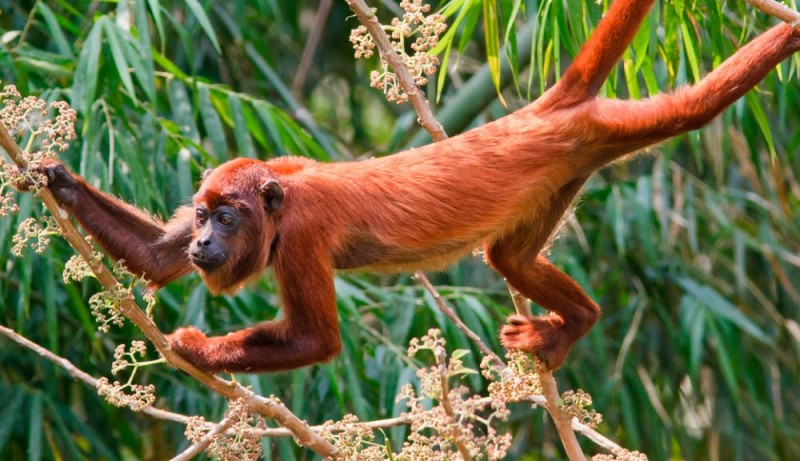
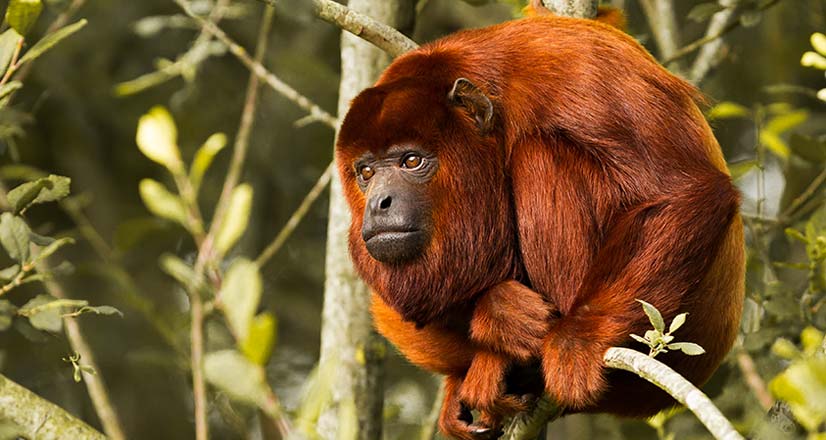
Red Howler Monkey (Alouatta seniculus): Their impressive and intimidating morning howl reverberates through the jungle and can be heard kilometers away.
-
Squirrel Monkey (Saimiri sciureus): Small, incredibly fast, and curious. They usually move in active groups of up to 50 individuals.
-
Brown Capuchin (Sapajus apella): Intelligent and stocky, they are often seen foraging for fruits and cracking nuts.
-
Titi Monkey and Saddleback Tamarin: Smaller, more elusive species that inhabit the middle strata of the forest.
D) Avifauna: A Birdwatcher’s Paradise
If you are an ornithology enthusiast, Sandoval Lake will exceed all your expectations. Hundreds of species have been recorded in its vicinity.
-
The Hoatzin (Opisthocomus hoazin): Known as the “dinosaur bird,” this bizarre, prehistoric-looking ruminant bird has claws on its wings when young. It inhabits the low branches touching the water and emits a distinct, wheezy hiss.
-
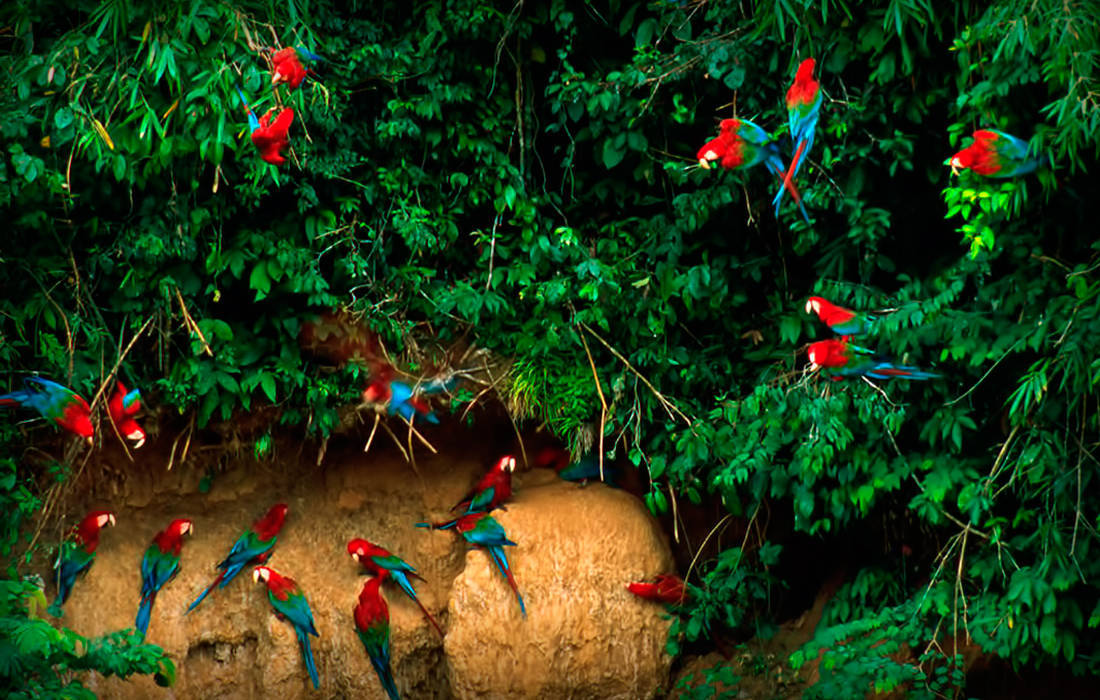
Macaws and Parrots: Red-and-green macaws (Ara chloropterus) and blue-and-yellow macaws (Ara ararauna) constantly cross the sky over the lake at dawn, flying in pairs and filling the air with their loud, characteristic squawks.
-
Kingfishers, Herons, and Ospreys: Diverse species of wading birds and raptors patrol the waters in search of unsuspecting fish.
4. Cost and Budget Analysis: How Much Does It Cost?
Traveling to the Peruvian Amazon requires clear financial planning. Being regulated by the government within a National Reserve, there are mandatory entry fees and logistical costs to consider. Below is a breakdown of the average prices updated for 2026.
A) Official Entrance Fees
To enter the Tambopata National Reserve, the National Service of Natural Areas Protected by the State (SERNANP) requires an entry fee.
-
Foreign Tourists: Approximately $20 USD per person.
-
Peruvian Citizens: Around $10 USD.
-
Note: If you book an all-inclusive package with an eco-lodge or authorized agency, this fee is almost always included in the total price. Always double-check this before booking.
B) Option 1: Full-Day Tour from Puerto Maldonado
If you are short on time or on a tight budget, you can choose to stay in a budget hotel in the city of Puerto Maldonado and book a full-day tour to Sandoval Lake.
-
Average Cost: Between $50 USD and $80 USD per person.
-
What’s included?: Round-trip motorized boat transport from the city port, bilingual guide, reserve entrance fee, a traditional lunch (usually an Amazonian Juane wrapped in bijao leaves), and the paddle canoe tour on the lake.
-
Disadvantage: You will miss the most magical moments on the lake: the misty sunrise and the night search for black caimans, as you must leave the reserve before nightfall.
C) Option 2: All-Inclusive Eco-Lodge Packages (Recommended)
To truly experience the Amazon, it is highly recommended to spend the night inside or on the edge of the reserve on a 3-Day/2-Night or 4-Day/3-Night package.
-
Budget / Mid-Range Lodges: $120 to $190 USD per night, per person. These are rustic but comfortable cabins with private bathrooms and tasty local food.
-
Premium / Luxury Lodges: $250 to $450+ USD per night, per person. Includes high-end ecological architecture bungalows, gourmet Amazonian fusion cuisine, open bar services, and top-tier private or semi-private naturalist guides.
5. The Best Eco-Lodges: Where to Stay
Your choice of accommodation will completely shape your experience. In the Sandoval Lake area, there are two distinct logistical options: lodges located inside the reserve (with direct and immediate access to the lake) and lodges located outside the reserve (on the banks of the Madre de Dios River, which visit the lake via half-day excursions).
1. Sandoval Lake Lodge (Best for Lake Proximity)
If your number one priority is wildlife viewing and nature photography, this is the place to be. Sandoval Lake Lodge is one of the very few accommodations legally authorized to operate inside the Tambopata National Reserve, perched on a low cliff directly overlooking the water.
-
The Experience: Because you are physically on the lake, you can wake up at 5:00 AM, walk to the lodge’s private dock, and be paddling in the mist before the first rays of sun hit the water. You completely bypass the daily 3-kilometer hike that visitors staying outside the reserve must do.
-
Facilities: The structures are built with local wood respecting Amazonian aesthetics. Rooms feature fine insect screens on the windows, private bathrooms, and hot water (heated by solar panels). Electricity is provided by a generator during specific times of the day (typically at midday and in the evening to charge batteries).
-
Target Audience: Travelers focused on raw nature, wildlife photographers, and couples seeking absolute tranquility and a digital detox.
2. Maloka Sandoval Lodge (Best Mid-Range Option)
Located just a few minutes’ walk from the canal that connects to the lake, Maloka Sandoval Lodge stands as the perfect alternative for those who want quick access to the aquatic ecosystem without paying premium rates.
-
The Experience: Locally owned and operated, this lodge stands out for the warmth of its staff and the deep knowledge of its native guides, many of whom grew up in the nearby communities of the Madre de Dios River.
-
Facilities: Well-ventilated, independent wooden cabins with mosquito nets on the beds and functional private bathrooms. Meals are prepared with fresh, local ingredients sourced from local family farms.
-
Target Audience: Mid-range travelers, independent backpackers, and community-based conservation enthusiasts.
3. Inkaterra Hacienda Concepción (Best for Sustainable Luxury)
For those seeking absolute comfort, impeccable service, and a touch of sophistication in the middle of the jungle, the renowned Peruvian brand Inkaterra offers a stunning property: Hacienda Concepción. This lodge is not located inside the reserve itself, but on a private ecological concession on the banks of the Madre de Dios River.
-
The Experience: Staying here means immersing yourself in the history of the region’s ancient cocoa and rubber plantations while enjoying world-class hotel standards. From here, they coordinate outstanding day excursions to Sandoval Lake, crossing the river and hiking the reserve’s trail with top-tier naturalist guides equipped with high-end spotting scopes.
-
Facilities: Exquisitely decorated luxury cabanas and rooms in the main hacienda. They feature high-thread-count cotton sheets, spacious bathrooms, a spa with treatments based on Amazonian plants, and a restaurant serving gourmet fusion menus.
-
Target Audience: Luxury travelers, families with young children who require high comfort standards, and honeymooners.
6. How to Get There: Step-by-Step Logistics
Getting to the jungle can seem like an ordeal, but the infrastructure in southern Peru has simplified the process significantly. Here is the exact logistical route you will follow:
[Your Origin: Lima / Cusco]
       │  (Commercial Flight to Puerto Maldonado)
       ▼
[Padre Aldamiz Airport - Puerto Maldonado]
       │  (Lodge Minivan Transfer - 15 mins)
       ▼
[Puerto de Capitanía / River Port]
       │  (Motorboat ride down Madre de Dios River - 40 mins)
       ▼
[SERNANP Ranger Station - Reserve Entrance]
       │  (Guided flat hike on jungle trail - 3 km / 1 hour)
       ▼
[Sandoval Canal Dock]
       │  (Paddle canoe navigation - 20 mins)
       ▼
[Arrival at Sandoval Lake!]
7. Essential Packing List and Travel Tips
The tropical rainforest is unforgiving to those who are unprepared. Constant humid heat, sudden downpours, and abundant insects require you to pack smart.
Clothing Checklist
-
Lightweight Long Pants (2 or 3 pairs): Avoid jeans at all costs; they take forever to dry in 90% humidity. Opt for quick-dry hiking pants. Long pants are your main defense against mosquitoes and thorny plants.
-
Breathable Long-Sleeve Shirts: Same principle as pants. Light colors (khaki, olive green, gray, beige) are ideal. Avoid dark blue or black clothing, as these colors strongly attract biting insects like horseflies.
-
Long Cotton Socks: You will need to wear them over your pants when putting on your rubber boots to prevent uncomfortable chafing on your calves.
-
Rain Poncho or Waterproof Shell: It can go from a scorching sun to a torrential downpour in fifteen minutes. Always carry a lightweight poncho in your daypack.
Gear and Optics
-
Binoculars (Absolutely Essential): If you visit Sandoval Lake without binoculars, you will miss half the experience. Many birds and monkeys are 30 to 40 meters away in the canopy. A standard pair of $8\times42$ or $10\times42$ binoculars will completely transform your sightings.
-
Telephoto Camera Lens: Smartphones are great for sunset landscapes, but not for capturing a macaw’s face on the far shore of the lake. A lens of at least 300mm is highly recommended for photographers.
-
Dry Bags: Crucial for protecting cameras, phones, and passports from sudden rain or heavy morning humidity.
-
Power Banks: Because most lodges inside the reserve operate on limited generator hours, having a portable charger ensures your devices never die during a night walk.
-
Cash (Peruvian Soles): There are no ATMs or reliable cell phone signals to process credit cards inside the reserve. Bring cash in small denominations for buying local crafts, purchasing extra drinks at the lodge bar, or tipping your guides.
8. Summary Comparison: Sandoval Lake vs. Other Amazon Destinations
| Feature | Sandoval Lake (Lower Tambopata) | Upper Tambopata (Deep Clay Licks) | Manu National Park (Reserved Zone) |
| Travel Time from Airport | Short (1.5 to 2 hours total) | Long (4 to 6 hours by motorboat) | Very Long (1 to 2 days by road & boat) |
| Overall Cost | Budget-friendly to Moderate | Moderate to High | High to Very High |
| Wildlife Focus | Giant Otters, Caimans, Lake Birds | Macaw Clay Licks, Capybaras, Tapirs | Pristine ecosystems, Jaguars, rare birds |
| Comfort Level | High range (rustic to luxury) | Mostly Mid-to-High Comfort | Mostly rustic and research-oriented |
| Best For | Short trips, families, budget-conscious | Birdwatchers, 4-5 day itineraries | Hardcore adventurers, researchers |
9. Conclusion: The Final Verdict
When all is said and done, Sandoval Lake is not only worth it—it deserves a top spot on your Peruvian itinerary.
Its magical combination of easy logistics, pristine scenery, and high wildlife concentration makes it a truly unique ecotourism destination. It is the place where the untamed majesty of the Amazon becomes accessible to the everyday traveler without losing its raw, mystical essence.
Few experiences on Earth compare to the feeling of gliding silently across the misty waters of Sandoval at sunrise, listening to the prehistoric call of the howler monkeys as a family of giant otters emerges right before your eyes. If you are willing to lace up your hiking boots, unplug from the digital world, and embrace the humid life of the rainforest, Sandoval Lake will stay with you forever.