The Andean Cock-of-the-Rock in Manu National Park: The Ultimate Guide to Wildlife Viewing in the Peruvian Cloud Forest
The Amazonian biome of southeastern Peru holds one of the most colorful, noisy, and fascinating spectacles in the animal kingdom: the complex courtship ritual of the Peruvian Cock-of-the-Rock (Rupicola peruvianus). Known in the native Quechua language as the tunki, this magnificent creature is not only the National Bird of Peru but also the ultimate symbol of the biological richness hidden within the pristine cloud forests that tumble from the Andes Mountains down into the vast eastern lowlands.
If you are planning an ecotourism expedition to the world-renowned Manu National Park, which spans across the rich geographic boundaries of the Cusco and Madre de Dios regions, witnessing the mating ritual of this passerine bird should be at the absolute top of your travel itinerary. Throughout this exhaustive guide, we will provide you with an incredibly detailed scientific, logistical, and geographical breakdown so you can discover the best observation sites (known as leks), understand the bird’s unique behavior, and choose the finest eco-lodges and transport options leaving from the historic city of Cusco.
1. Manu National Park: A Geographic and Biological Megadestination
To truly comprehend why Manu National Park is considered the premier location on the planet to spot the Andean cock-of-the-rock, we must first look at its incredible geography. This massive natural area protected by the Peruvian state spans an astonishing altitudinal gradient. It ranges from the freezing high-Andean puna of Cusco at 4,000 meters (13,123 feet) above sea level down to the vast, flooded alluvial plains of the lower Amazon basin in Madre de Dios at just 250 meters (820 feet) above sea level.
This sudden, steep geographic drop creates a succession of unique microclimates and distinct ecological zones:
-
The High-Andean Zone and Puna: Characterized by cold grasslands and dwarf elfin forests.
-
The Cloud Forest or High Jungle (Yungas Peruanas): A mystical ecosystem permanently blanketed in thick mist. It features high humidity levels, steep mountain slopes, and lush vegetation saturated with mosses, ferns, wild orchids, and bromeliads. This is the exclusive habitat of the cock-of-the-rock.
-
The Lowland Rainforest: The heart of the Amazonian plain, dominated by massive winding rivers, oxbow lakes (cochas), and towering Brazil nut and mahogany trees.
Manu is officially cataloged as one of the most biodiverse zones in the entire world. Within its borders, more than 1,000 species of birds, 200 species of mammals (including jaguars and spectacled bears), and countless reptiles and insects coexist. Within this dense green paradise, the eastern slopes of the Cusco Andes serve as the perfect evolutionary stage for the tunki.
2. Biology and Behavior of the Tunki: King of the Mist
The Andean cock-of-the-rock exhibits striking sexual dimorphism, meaning males and females have radically different physical appearances. This physical differentiation is the driving force behind their complex reproduction strategy.
The Male: A Flash of Fire in the Forest Understory
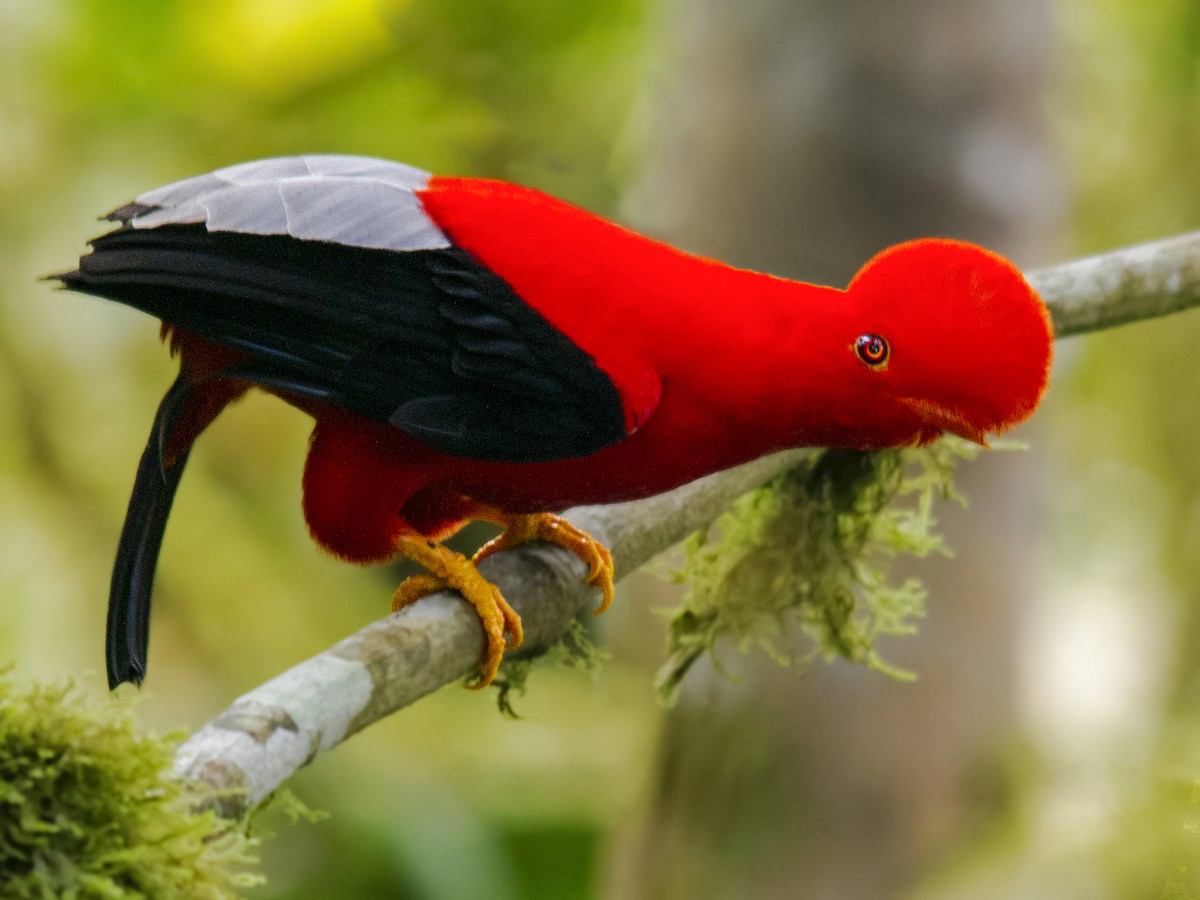
The adult male is unmistakable and visually stunning. He possesses a brilliant, fiery red-orange plumage covering most of his body, which contrasts sharply with jet-black wings and tail feathers, and distinctive pearl-gray scapular feathers.
Without a doubt, his most famous anatomical feature is his large, disk-like crest. This fan of feathers remains permanently erect over his short bill. The crest conceals his beak during visual displays and serves as a powerful visual signal to attract females. His eyes are an intense, piercing yellow or orange, and his legs are short but robust, perfectly adapted for gripping tightly to the damp, mossy branches of the cloud forest understory.
The Female: Master of Camouflage
In absolute contrast, the female cock-of-the-rock has a dull, muted brownish-burgundy or dark tan plumage. Her crest is notably smaller and far more discreet. This lack of flashy color is a deliberate evolutionary defense mechanism. Because the female is solely responsible for building the nest, incubating the eggs, and feeding the chicks on dark, damp rocky cliffs or caves, her muddy coloration allows her to blend perfectly with her surroundings, keeping her safe from apex predators like harpy eagles, ocelots, and large tree snakes.
+-----------------------------------------------------------------+
|          SEXUAL DIMORPHISM IN THE ANDEAN COCK-OF-THE-ROCK       |
+----------------------------------+------------------------------+
| Feature                          | Male                         | Female
+----------------------------------+------------------------------+
| Plumage Color                    | Brilliant red-orange         | Dull dark brown/tan
+----------------------------------+------------------------------+
| Crest Size                       | Large, permanent, dramatic   | Small, discreet
+----------------------------------+------------------------------+
| Reproductive Role                | Competes in the Lek          | Exclusive nesting & care
+----------------------------------+------------------------------+
| Display Habitat                  | Mid-level understory branches| Damp, mossy rocky cliffs
+----------------------------------+------------------------------+
3. The Lek Phenomenon: The Greatest Dance in the Amazon
The primary reason avid birdwatchers and professional wildlife photographers travel to Manu National Park is to witness a lek. In biology, a lek is a communal display area where a group of males gathers regularly throughout the year to compete peacefully for the attention of visiting females.
How the Mating Ritual Unfolds
Starting around 5:00 AM, before the first rays of morning light break through the thick cloud forest canopy, the males begin arriving at a specific sector of the forest—usually a rocky canyon or a steep slope near a rushing mountain stream. Each male takes possession of a specific branch, known as his “display perch.”
The moment one or more females silently fly into the lek area, the males enter a state of absolute frenzy:
-
Visual Displays: They bob their heads up and down, expand their crests forward until their bills are completely hidden, arch their bodies, snap their wings, and hop from branch to branch to showcase their brilliant colors.
-
Vocalizations: They emit a series of harsh, raucous, guttural sounds that sound like a mix between a pig’s grunt and a distorted chicken squawk. The synchronized chaos of 10 to 20 males vocalizing at once inside the echo chamber of the cloud forest is completely deafening and thrilling to hear.
The female flies calmly above the perches, minutely evaluating the performance, plumage quality, and energy of each competitor. After rigorous inspection, she lands on the perch of the winning male, giving him a gentle peck on the shoulder to signal her acceptance. The actual mating lasts only a few seconds, after which the female immediately leaves the lek to build her nest in isolation, while the male remains on his perch, eagerly waiting for the next female to arrive.
4. Where Exactly is the Lek Located in Manu?
While Manu National Park is enormous, the cock-of-the-rock lives exclusively within the narrow altitudinal band of the high jungle and cloud forest, specifically between 500 and 2,400 meters (1,640 to 7,870 feet) above sea level. This means if you travel straight to the lowland Amazon basin (such as Boca Manu or the Manu River deep zone), you will not find this species.
The premier geographic point to observe this behavior is located in the Buffer Zone of Manu National Park, along the mountain road that connects the Cusco region with the town of Pilcopata and the river port of Atalaya. The absolute epicenter of this activity is the scenic Kosñipata River Valley in the province of Paucartambo, Cusco.
The San Pedro Lek: The Number One Viewing Site in the World
Situated at an altitude of approximately 1,400 meters (4,593 feet) above sea level, the San Pedro sector houses one of the most accessible, densely populated, and well-preserved cock-of-the-rock leks on the planet. Here, the forest canopy opens up just enough to allow the early morning light to cut through the mist, illuminating the birds’ display perches and allowing photographers to capture sharp images without disturbing the natural behavior of the colony.
5. Travel Logistics: How to Get There from Cusco Step-by-Step
Traveling to the cloud forests of Manu requires careful planning due to the winding, rugged geography of the eastern Andes. Below is the exact overland route you will follow starting from the historic imperial city of Cusco:
[City of Cusco] (3,400 m / 11,154 ft)
       │  (Overland travel via minivan - 3 hours)
       ▼
[Historic Town of Paucartambo] (2,900 m / 9,514 ft)
       │  (Winding mountain ascent - 1.5 hours)
       ▼
[Acjanaco Pass - Official Manu Entrance] (3,560 m / 11,679 ft)
       │  (Descend the unpaved road into the cloud forest - 2.5 hours)
       ▼
[San Pedro Sector / Kosñipata Valley] (1,400 m / 4,593 ft)
       │  (Arrival at the Leks and Eco-Lodges!)
Leg 1: Cusco to Paucartambo
Your journey begins early in the morning, heading east out of Cusco. The paved road cuts through picturesque Andean valleys and local farming communities. After about 3 hours, you will reach Paucartambo, a beautiful colonial town famous for its historic stone bridge and its world-renowned Virgen del Carmen festival in July. This is the perfect place to make a technical stop, enjoy a hot breakfast, and buy last-minute snacks and water supplies.
Leg 2: The Ascent to Acjanaco (The Gate to Manu)
Leaving Paucartambo, the vehicle begins a steep climb up an unpaved road that hugs the mountain ridges until it reaches Acjanaco Pass, standing at an impressive 3,560 meters (11,679 feet) of altitude. This is the official ranger station and entry point into Manu National Park. If the weather is clear, the lookout point at Acjanaco offers one of the most breathtaking views in South America: the jagged Andean peaks dropping sharply into a vast, endless sea of green clouds that marks the beginning of the Amazon basin.
Leg 3: Plunging into the Cloud Forest
From Acjanaco, the road descends sharply down the eastern slopes of the Andes. As you lose altitude, the crisp, thin Andean mountain air rapidly transitions into a thick, warm, highly humid environment. The dry mountain brush gives way to giant tree ferns, cascading waterfalls dropping right beside the road, and thick stands of wild Amazonian bamboo. After about 2 to 3 hours of careful mountain driving, you will finally arrive in the lush paradise of the San Pedro Sector (1,400 m)—the ultimate home of the cock-of-the-rock.
6. The Best Eco-Lodges to Stay in San Pedro and Kosñipata
To catch the morning lek at 5:00 AM, it is physically impossible to travel from Cusco on the same day. The only viable option is to spend the night at an eco-lodge located right within the cloud forest of San Pedro. Fortunately, this region boasts world-class sustainable accommodations that blend wildlife conservation with rural hospitality.
1. Cock of the Rock Lodge (The Ultimate Birdwatching Hub)
Owned by the prestigious Peruvian conservation NGO ACCA (Association for the Conservation of the Amazon Basin) and operated by specialized operators, Cock of the Rock Lodge is undisputedly the most famous and strategically located accommodation in the area.
-
The Location: It sits directly within a 506-hectare private cloud forest reserve in the San Pedro sector. The absolute best feature of this lodge is that it features its own private cock-of-the-rock lek, located just a short, easy 10-to-15-minute walk from the cabins along a flat forest trail.
-
Facilities: It offers extremely comfortable, clean wooden bungalows equipped with private bathrooms, hot water, and mosquito netting over the beds. The central open-air dining hall looks directly onto a botanical garden packed with active hummingbird feeders. Here, you can photograph over a dozen species of hummingbirds (like the spectacular Boissonneaua matthewsii) just a few feet away from your morning coffee cup.
-
Power and Connection: It runs sustainably on limited solar power during the evening to charge camera batteries. There is no cell phone signal or stable Wi-Fi internet, guaranteeing an authentic digital detox experience.
2. Manu Paradise Lodge (Comfort and Specialized Birding)
Located a bit further down the Kosñipata valley near the town of Pillcopata, Manu Paradise Lodge is an excellent alternative for travelers seeking a higher tier of comfort while maintaining an intimate connection with the tropical wilderness.
-
The Experience: This lodge features a modern infrastructure built in harmony with its jungle surroundings. From your private balcony, you can listen to the constant rushing sound of the nearby Kosñipata River. They organize daily early-morning excursions to the official San Pedro lek, utilizing highly specialized local guides who carry powerful spotting scopes to guarantee perfect views of the birds.
-
Facilities: Spacious rooms with premium finishes, large bathrooms with 24/7 hot water, and a restaurant serving traditional Peruvian and international fusion cuisine made with organic ingredients grown right in the region.
3. San Pedro Rural Guesthouses (The Budget/Backpacker Option)
For independent backpackers and budget-conscious birdwatchers, there are small family-run guesthouses located right along the edge of the road in the San Pedro sector.
-
The Experience: These spots offer very basic rooms with shared bathrooms and home-cooked meals prepared by local families. While they lack the premium amenities of the major eco-lodges, their great advantage is that they are located within short walking distance of the public trail leading to the main cock-of-the-rock lek lookout, allowing you to save significantly on private transport and tour costs.
7. Cost Breakdown and Budgets for 2026
Organizing a trip to Manu National Park to see the cock-of-the-rock involves managing a few financial variables. Depending on your travel style (all-inclusive tour vs. independent travel), the average estimated costs for this 2026 travel season are broken down below:
All-Inclusive Tours from Cusco (3 Days / 2 Nights)
This is the recommended route for the vast majority of international tourists due to the complexity of coordinating private transport on mountain roads and securing bookings at specialized cloud forest lodges.
-
Budget/Mid-Range Tours: Between $350 USD and $500 USD per person. This typically includes shared minivan transport from Cusco, accommodation at basic lodges, all field meals, and a shared bilingual naturalist guide.
-
Premium/Specialized Birdwatching Tours: Between $700 USD and $1,200+ USD per person. This includes private 4×4 transport, overnights at the exclusive Cock of the Rock Lodge, gourmet Amazonian fusion meals, all reserve entrance fees, and the undivided attention of a top-tier ornithology guide.
Independent Travel
If you are an experienced traveler fluent in Spanish and used to navigating rural South America, you can set up your own logistics:
-
Public Transport (Cusco – Paucartambo – Pilcopata): Local minivans and shared cars (colectivos) depart from the Calle Control area in Cusco. The average fare costs between $15 USD and $25 USD per way. You must tell the driver to drop you off exactly at the San Pedro sector.
-
Basic Lodging: Local family cabins charge between $20 USD and $45 USD per night for a basic double room.
-
Food: Local set menus (menús) in the small towns along the route cost around $4 USD to $7 USD per meal.
-
Lek Access Fees: Some local communities or private land owners where the lek viewing platforms are located charge a small maintenance fee ranging from $10 USD to $20 USD per person per viewing session.
8. Best Time to Visit: Season and Weather
The cloud forest of Manu is one of the wettest places on earth, receiving over 4,000 millimeters of rainfall per year. However, the reproductive behavior of the cock-of-the-rock varies throughout the year based on Peru’s two main tropical seasons:
The Dry Season (May to October) – Highly Recommended
While it is called the “dry” season, you should still expect passing showers in the cloud forest. However, the overall frequency and intensity of rain drop drastically.
-
Pros: The mountain roads from Cusco are in safe, optimal condition, and the risk of landslides is minimal. Trails are less muddy and easier to navigate. Days are brighter, providing excellent natural light for capturing crisp photos of the bird’s bright feathers without having to push your camera’s ISO to noisy limits.
-
Bird Behavior: The males attend the lek with total consistency every single morning, putting on high-energy displays due to intense reproductive competition.
The Rainy Season (November to April) – The True Amazon Challenge
During these months, the eastern slopes of the Andes receive torrential downpours, peaking in January, February, and March.
-
Cons: The dirt road to Manu frequently suffers delays due to rockfalls and mudslides (huaicos), which can heavily disrupt your travel timeline. Forest trails become slippery and challenging.
-
Pros: If you make it through, you will see the forest in its most vibrant biological state. Orchids and bromeliads are in full bloom, and the mountain rivers turn into massive, roaring waterfalls. The birds still visit the lek, but if the morning rain is too heavy, they will halt their active dancing and sit quietly under large leaves to protect their plumage.
9. Photography Tips for the Cloud Forest Lek
Photographing a cock-of-the-rock in its natural habitat is a major technical challenge. You are standing in the dim understory of a dense forest, very early in the morning, surrounded by heavy mist and low cloud cover. Available light is extremely scarce.
To ensure you head home with sharp, stunning images, apply these battle-tested field tips:
-
Use Fast Lenses (Wide Apertures): A prime telephoto lens or zoom lens with a constant aperture of f/2.8 or f/4 is the gold standard in Manu. If you use a basic kit lens with a maximum aperture of f/5.6 or f/6.3, your camera will be forced to raise the ISO to extreme levels, introducing massive digital noise into your shots.
-
Keep an Eye on Shutter Speed: The males move with surprising speed when jumping and snapping their wings during courtship displays. To freeze their movement, aim for a minimum shutter speed of 1/250 or 1/500 of a second. If a bird is sitting completely still on his perch singing, you can drop down to 1/60 of a second by utilizing a sturdy tripod.
-
Bring a Sturdy Tripod or Monopod: Because of the low light and the weight of long telephoto lenses (like a 300mm or 400mm), shooting handheld will almost certainly result in blurry images. A lightweight carbon fiber monopod is perfect for moving quickly along the narrow observation decks of Manu.
-
Flash is Strictly Prohibited: Using external flashes or built-in white flashlights is strictly banned at all leks within Manu National Park. The bright burst of light can temporarily blind the birds, causing massive stress and forcing them to permanently abandon the lek site, ruining the breeding season for the colony. Work exclusively with the available ambient light.
-
Adjust Your White Balance: Because the morning light is heavily filtered through the dense green canopy and blue mountain mist, automatic white balance often produces overly cold, bluish images. Set your white balance manually to “Shade” or “Cloudy” to instantly bring out the natural warmth and rich saturation of the bird’s red-orange plumage.
10. Packing List for the Manu Cloud Forest
The fast-changing weather of Manu’s high jungle requires smart layering. Make sure to pack these essential items:
-
Layered Clothing: During the drive from Cusco to Acjanaco, you will cross high mountain passes where you will need a warm beanie, gloves, and a down jacket. As you descend into San Pedro, you will shed these layers for lightweight hiking shirts.
-
Heavy-Duty Rain Poncho: Umbrellas are useless on narrow jungle trails. A high-quality, durable rain poncho that can cover both you and your camera backpack is a lifesaver.
-
High-Traction Hiking Boots: Leave flat-soled sneakers at home. You need trail shoes with deep rubber lugs to prevent slips on steep, wet clay trails.
-
Waterproof Dry Bags: Essential for sealing your camera gear, lenses, phones, and passports if a sudden downpour hits while you are out on the trails.
-
High-Transmission Binoculars: A pair of $8\times42$ or $10\times42$ binoculars with good low-light capabilities is vital for appreciating the fine details of the bird’s crest and eyes in the dark forest understory.
11. Sustainability and Lek Etiquette
The Andean cock-of-the-rock is a sensitive species easily disrupted by unorganized human presence. Leks are critical to the survival of the species. If the colony feels consistently threatened by rowdy or intrusive tourist behavior, they will abandon the display site permanently, severely impacting local breeding populations.
To ensure your visit is completely ethical and sustainable, follow these golden rules of lek etiquette:
-
Wear Muted, Camouflage Colors: Avoid wearing bright colors like white, yellow, or solid red when heading to the lek. These colors stand out instantly against the dark green forest background, alerting the birds to your presence and causing them to retreat to the highest branches of the canopy where they cannot be seen. Stick to khakis, browns, and dark greens.
-
Maintain Absolute Silence: From the moment you step onto the lek trail, turn your cell phone to complete silent mode. Speak only in low, quiet whispers with your guide. The sound of human voices is interpreted by the birds as the immediate presence of a dangerous predator.
-
Stay on the Designated Platforms: Authorized leks in San Pedro feature wooden viewing blinds or hidden platforms designed to conceal human presence. Do not climb over the safety railings or venture into the thick brush trying to get a closer photo. Doing so can destroy fragile undergrowth and disrupt hidden nesting sites of other bird species.
-
Hire Local, Certified Guides: By choosing tour operators that hire local guides from the Kosñipata valley, you ensure that the activity is run under strict conservation standards. Furthermore, your money directly supports the rural economies of the communities living near the park, proving that wildlife tourism is a highly profitable and sustainable alternative to destructive practices like illegal logging or slash-and-burn farming on the Andean slopes.
12. At a Glance: Manu vs. Other Peruvian Cock-of-the-Rock Destinations
Peru is a global birdwatching superpower, and while there are a few other locations across the country where you can see the cock-of-the-rock, Manu’s cloud forest stands out for several key ecological reasons:
| Viewing Destination | Subspecies Found | Lek Accessibility | Average Male Count at Lek | Eco-Lodge Infrastructure | Additional Biodiversity Highlights |
| San Pedro (Manu, Cusco) | Rupicola peruvianus (Eastern subspecies: intense fiery red-orange) | High (Direct access via road from Cusco) | Very High (15 to 25 active males per lek) | Excellent (Specialized birding properties like Cock of the Rock Lodge) | Spectacled bears, woolly monkeys, hundreds of unique hummingbirds, pristine Andean-Amazon transition. |
| Gocta Waterfall (Amazonas, Northern Peru) | Rupicola peruvianus (Northern subspecies: lighter orange hue) | Moderate (Requires long mountain hikes from Cocachimba village) | Moderate (5 to 10 males per lek) | Good (Comfort hotels and local community stays) | Marvelous Spatuletail hummingbird, yellow-tailed woolly monkeys, historic Chachapoyas archaeological sites. |
| Alto Mayo Protected Forest (San Martín) | Rupicola peruvianus (Northern subspecies) | High (Located right off the main northern highway) | Moderate (8 to 12 active males) | Basic to Intermediate (Local research stations and rural lodges) | Endemic orchids, San Martin titi monkeys, rare cloud forest endemic birds. |
13. Summary: A Life-Changing Wildlife Encounter
Embarking on a journey into the mystical cloud forests of Manu National Park to witness the ancient courtship dance of the Andean Cock-of-the-Rock is one of the most rewarding wildlife experiences you can find in South America.
As you descend from the high Andean peaks of Cusco into the deep tropical valleys of Kosñipata, you don’t just get to cross a beautiful bird off your bucket list—you get to witness the raw, uninterrupted evolutionary processes of the upper Amazon basin. The sight of a brilliant red-orange male leaping through the morning mist of San Pedro, surrounded by prehistoric tree ferns and wild orchids, is a magical moment that will stay with you long after you leave Peru. Pack your binoculars, choose a sustainable lodge, and get ready to experience the deep, wild secrets of Manu!